Project schedule #6 Rear Extension in Hampton Hill

 
hampton-hill-extension-living-01.jpg

Project schedule

Year: 2016-2017

Location: Hampton Hill, London Borough of Richmond upon Thames

RIBA Design Stages: 0-5

Architect:

Square One Architects

Structural Engineer:

Wallace Wheating

Building Control:

Building Control Approval

This project for a rear extension in Hampton Hill dates to 2016.

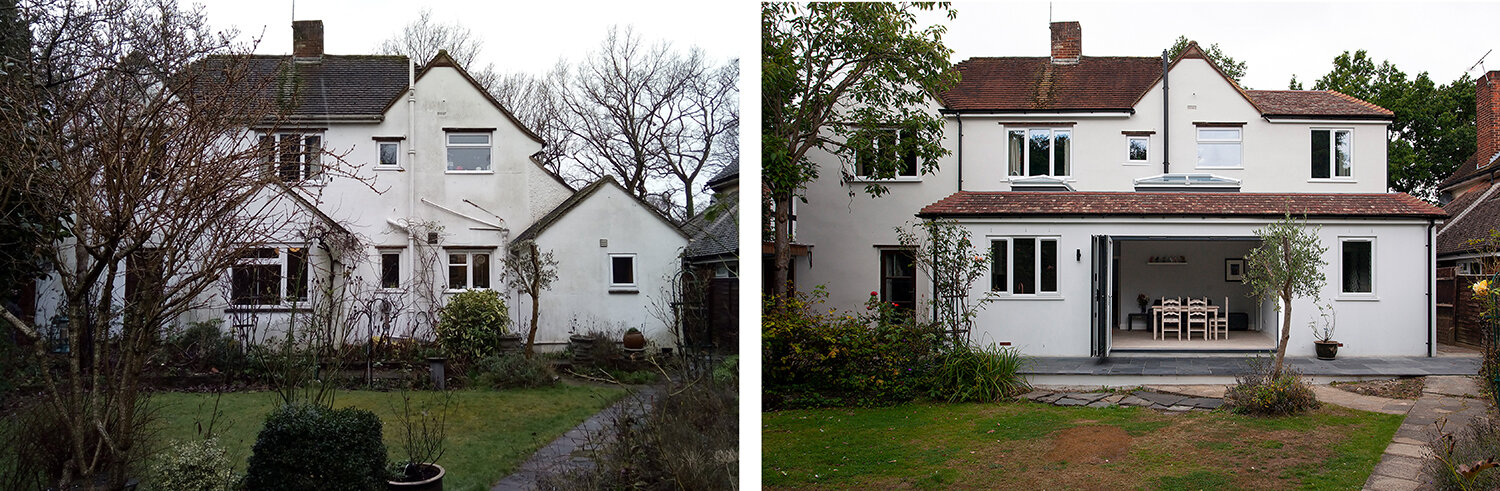
The clients, a retired couple, asked us to extend their property to the back. The existing house was a typical 1930’s semi-detached dwelling with a large garden to the rear. The clients’ initial brief was for a straightforward three meters rear extension with some internal alterations that would allow them to have an open plan layout, however they had an additional request: to retain a sunny corner in their outdoor patio. This led to the decision to design a three meters rear extension built under Permitted Development that would not use the full width of the rear garden in order to retain the sunny corner that our clients loved so much.

In order to highlight this design intention, we proposed to have an L-shaped window that would provide views to the rear garden and to the side patio at the same time. A set of large French Doors was then designed to allow access to the site patio. The client was also very keen to use triple glazed Swedish windows and chose West Coast Windows as their supplier.

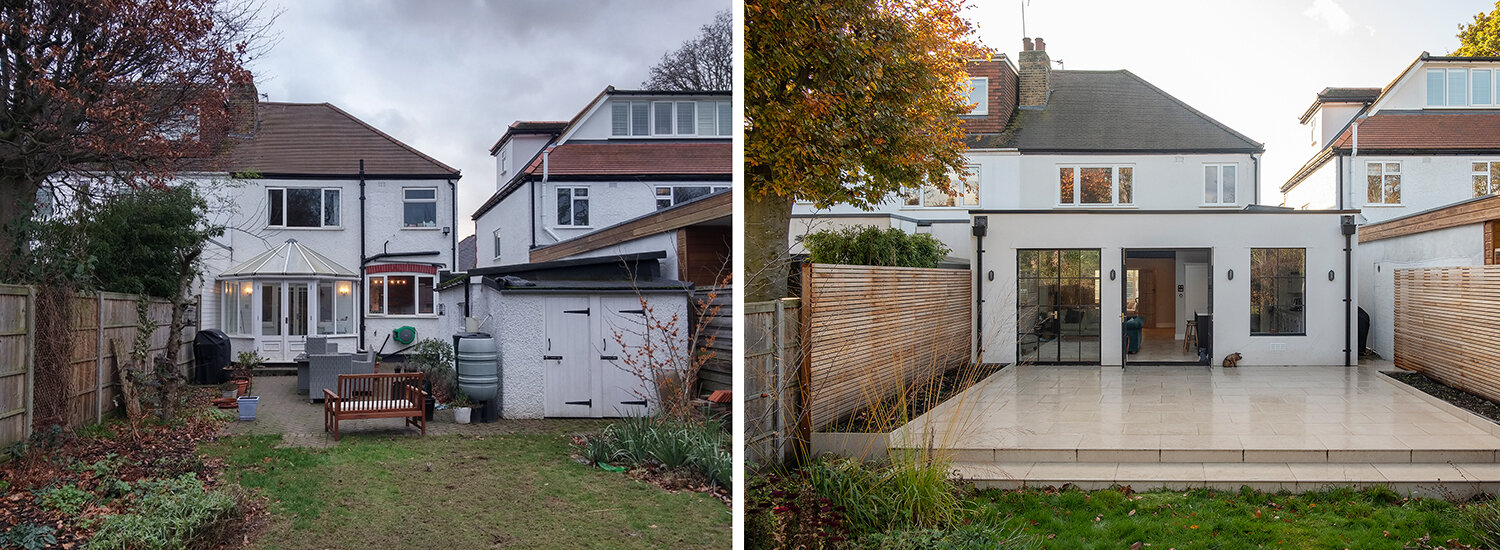
It was agreed with the client to have a flat roof extension reminiscent of the 1930’s minimalist approach that would create a nice contrast with the existing style of the house. In order to highlight this minimalist approach, we concealed all the rainwater pipes within the new walls.

The same logic informed the materials inside the extension where a herringbone wood floor was chosen for both the existing and the new section.

As we always do, we simulated the amount of daylight that the extension would receive depending on the moment of the year to guarantee that the new new space would be very bright at any moment of the year without any overheating.

The result is an extension that enhances the existing building and is very cohesive in terms of interior design with the rest of the property. In this circumstance we worked with an interior designer who happened to be our clients’ daughter in terms of internal materials and color palette. It was a very successful project that pleased all the parties involved.

Before and after images

Rear elevation

Rear elevation

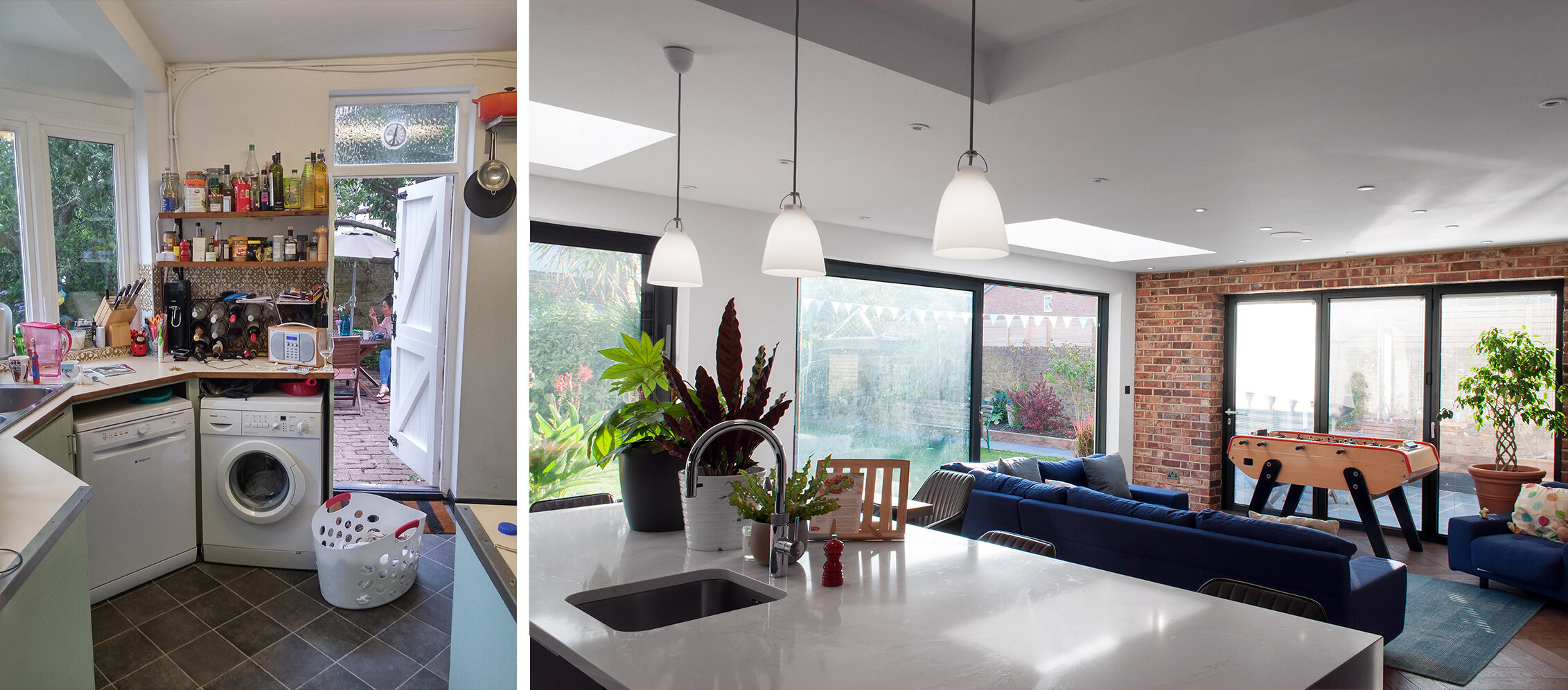
Dining and sitting area

Dining and sitting area

Project schedule #5 House Extension in Byfleet and New Haw

 
byfleet-extension-open-plan-kitchen-01.jpg

Project schedule

Year: 2018-2019

Location: Byfleet and New Haw, Runnymede Borough Council

RIBA Design Stages: 0-5

Architect:

Square One Architects

Structural Engineer:

Glencross & Hudson

Building Control:

Assent Building Control

This project was for an extension to a large detached house in Byfleet and New Haw for a family of three with a small child.

When the client got in touch with us in first instance, we visited the site and found that the house needed a renovation. The client was also not satisfied with the ground floor arrangement that was very partitioned and formed rooms that where both small and dark.

At first floor level the layout was more acceptable, however the house lacked the presence of a real master bedroom with a dressing area and an en-suite bathroom, which is something that you would expect from a property of this size.

Our brief was to extend a house with a rear extension and form a new open plan layout including a kitchen, dining area and sitting area. The client also requested a first-floor side extension on top of an existing garage that would provide space for an en-suite bathroom and dressing area linked to an existing bedroom.

We considered two options for the existing garage. The first one was to retain it and build on top of it and the the second one was to demolish and rebuild. As it often happens in these cases the option to replace the existing garage ended up being more cost-effective. It is not unusual to find period structure that are not able to carry any extra load from a structural point of view, especially at foundation level. In these instances, we always suggest our clients to hire a builder for a couple of hours, perform several trial pits and then submit the results to a structural engineer that will decide whether the existing structure is suitable or not. All the details will then need to be confirmed with Building Control.

The ground floor rear extension also features a set of large bi-fold doors that opens towards the rear garden and a window in correspondence of the kitchen sink. A set of two large flat roof lantern skylights also help bringing daylight in the new open plan area.

The first-floor side extension also features rear and front windows and a large skylight that guarantees uniform levels of daylight throughout the whole floor plan.

The clients’ feedback was very positive, and we appreciated hearing that they used their new spaces in a more practical way with their toddler always in sight. That's a big advantage of open plan layouts!

Before and after images

Rear elevation

Rear elevation

Kitchen and dining area

Kitchen and dining area

Front elevation

Front elevation

Project schedule #4 House Extension in Barnes

 
barnes-extension-open-plan-kitchen-02.jpg

Project schedule

Year: 2017-2019

Location: Barnes, London Borough of Richmond upon Thames

RIBA Design Stages: 0-5

Architect:

Square One Architects

Structural Engineer:

Glencross & Hudson

Building Control:

Building Control Approval

We started this project in 2017 for the client, a family of two.

The brief included a ground floor rear extension and a loft conversion to an existing terraced house in Barnes, South West London. The property fell within the Barnes Green Conservation Area.

As it often happens in these cases the challenges were not just architectural and structural. Planning in these instances can represent a potential roadblock, especially with the property falling in a Conservation Area.

The proposals were discussed with the client and then agreed with the planning officers. In this case we worked very hard with the Council proving the presence of similar precedents on the road and discussing the best design for the roof in order to be in keeping with the style of the Conservation Area. The initial proposals for a larger rear dormer was amended to allow for two smaller conservation style lead dormers that were welcome by the Council.

The property was also extended to the rear in order to form a new open plan layout with a galley kitchen opening on a patio that constitutes the only outside area of the house. In order to maximize the feel of space between the inside and the outside it was decided to have a flush threshold between the floors and use the same tiles for both the kitchen area and the patio. A set of large sliding doors also helped to create the feeling of a seamless transition between indoor and outdoor space. This project is an example of how good design can help maximize the spatial feeling even when square footage is limited.

An additional technical complication was the presence of a manhole within the existing property which had been double sealed. In order to carry out our extension and alterations we had to move the manhole to the new patio and reach an agreement with Thames Water.

We also pushed both the contractor and structural engineer to conceal the new structure within the existing ceiling to form a smooth transition between the various spaces at ground floor level.

In the end we were very pleased with the result and consider this project to be extremely successful.

Before and after images

Ground floor kitchen and dining

Ground floor kitchen and dining

Ground floor patio and kitchen area

Ground floor patio and kitchen area

Second floor guest bedroom

Second floor guest bedroom

House refurbishment and extension in Hampton Hill completed

Our project for a house refurbishment and extension in Hampton Hill has been completed. You can check the final pictures here.

hamtpon-hill-extension-kitchen-detail.jpg

Our project for a full house extension and refurbishment in Hampton Hill has been finally completed. This was a remarkably interesting project with a client who proactively engaged in a dialogue with the Architect throughout the whole design phase.

The project started as a ground floor extension and full house redevelopment that would have eventually included a second phase with a loft extension. The client wanted a project that would consider both phases of the design at the same time to avoid any inconsistency at a later stage. As it often happens the clients plans had to change halfway and they decided to reduce the scope for the ground floor extension and carry on with the construction of the loft extension in one single phase.

Our approach has been flexible, and we redesigned parts of the project to exclude certain sections of the rear extension. The revised project included most of the internal alterations that would enhance the property as a whole in particular turning the existing stair 90 degrees to be parallel with the house.

By the end of the project, the property gained two extra bedrooms and one family bathroom at second floor level. Turning the stair 90 degrees allowed to provide a more logical layout at both the ground and the first-floor level. The stair benefits from a skylight at second floor level that provide daylight for the circulation whole space. This is a rare feature in these types of properties, and we feel that the presence of natural daylight in the middle of the house should always be welcomed.

We would like to take this opportunity to thank the client for their involvement at all stages and the contractor for building an extension that reflects our design. The construction process was overall very seamless, and this is due to the professionalism of the builders and the precision of the instructions included in our drawings package.

Rear extension in Kingston now completed

Our project in Kingston for a rear extension has now been completed. Find more information and completion photos here

rear-extension-kingston-external-03.jpg

Our project for a rear extension to a historic house in Kingston has been completed.

The client came to us in 2018 with a request to remove an existing unused conservatory with a solid rear extension that would supply a generous amount of daylight whilst being perfectly useable throughout the year.

The client, a retired couple, also requested Square One Architects to overlook the construction of the extension since they lived half of the year in the United States.

At the beginning of the project we tabled several options that used the same existing footprint as the original conservatory. Following the first few meetings it was decided to carry out a rear extension with a pitched roof that would be in keeping with the character of the existing historic property and the area in general.

The client also decided to use welsh slates for the roof that is a typical material in this type of houses.

Following planning we worked on the building control and tender package obtaining building control approval and several quotes for our clients’ consideration.

At the end of this stage the client chose a contractor that managed to build the project with a limited amount of supervision from our part, given the very detailed instructions included in our drawings that we provided at detailed design and pre-construction stage

The result is a beautiful rear extension that uses traditional materials welsh slates, reclaimed bricks and white windows with a contemporary spin.

Crittall style doors for a project in Hampton

We love Crittal style doors and windows. In this instance the doors were supplied by Fabco Sanctuary

hampton-extension-exterior-rear-detail.jpg

For the second time in a row we used Crittall style doors and windows supplied by Fabco Sanctuary for a project of ground floor rear extension in Hampton.

In this instance the client approached us after having seen our project for a rear extension in Teddington and asked to use the same type of doors that had been used in that instance. We were very glad to adopt the same solution for this project because we are big fans of these types of steel doors and windows that maximize daylight and views thank to their thin frames.

Crittall doors and windows have a long history in Britain. These types of steel doors and windows frames have been fabricated since the 1930’s. Crittall remains one of the most important manufacturers of these steel doors and windows, however there are several other companies that provide competitive “Crittall style” frames.

Modern thermal requirements meant a change in the design of the frame to include double glazing and thermal breaks.

Despite not being the most thermally efficient doors and windows on the market these types of frames manage to achieve levels of transmittance that are generally accepted by building control.

We feel that the industrial look of these doors and windows along with the simple lines of a minimal white flat roof extension provide character and contrast to extensions carried out for houses that date back to the 1930`s or similar period.

The project has been now completed and the final pictures can be seen here.

Penthouse in Walthamstow: terrace

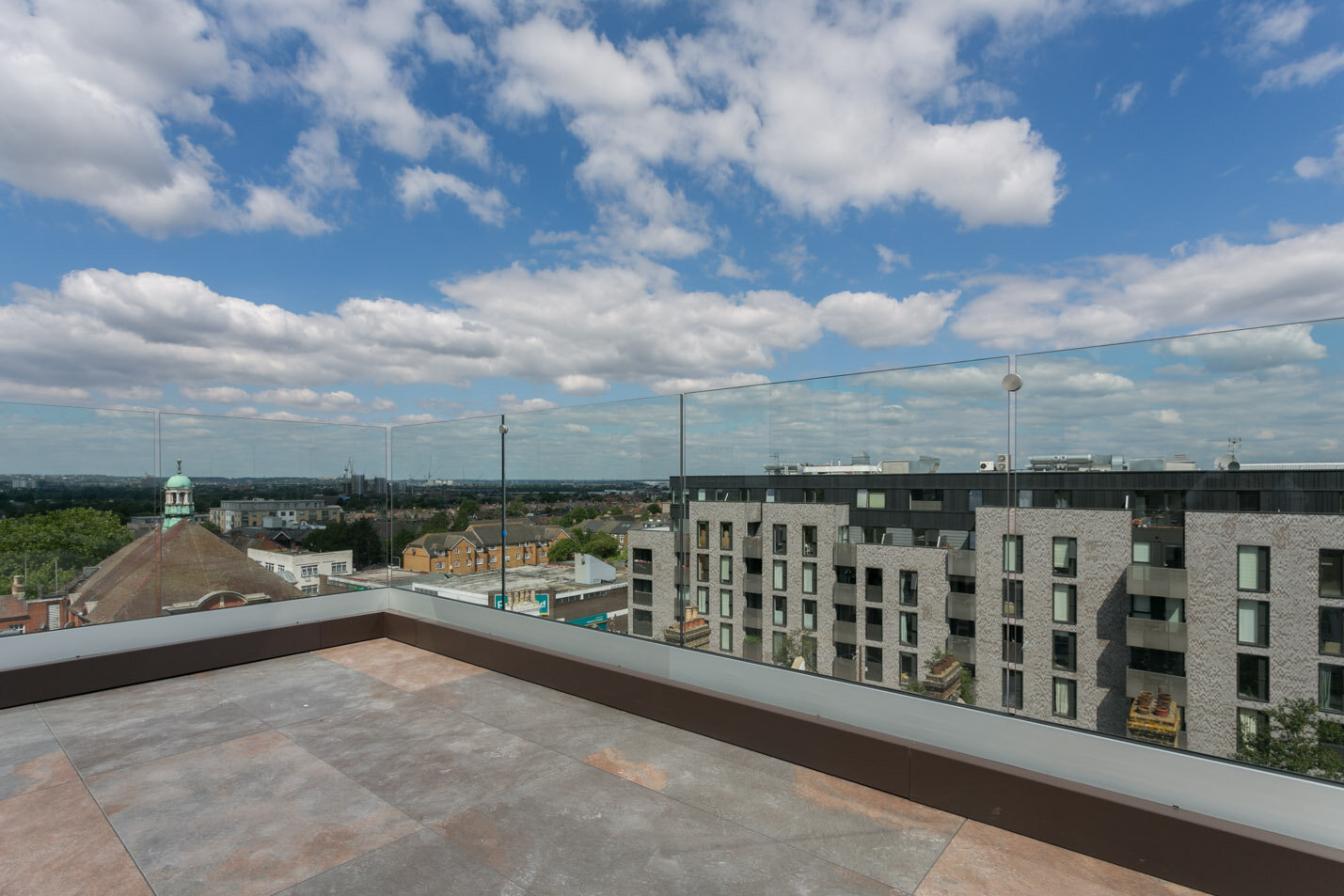
An external view of the penthouse flat in Walthamstow. The large terrace provides great views of London

walthamstow-residential-building-external-01.jpg
walthamstow-residential-building-terrace.jpg

The penthouse for this project of a multi-storey residential building in Walthamstow represents one of the highlights of this project.

Set on the 5th and 6th floor of the building, the penthouse design was the initial reason why the client approached us in first instance.

The initial idea was for Square One Architects to be involved in the redesign of the internal layout of these two floors. With time the project scope became larger to include the other floors off the property.

Our contribution to the project included the rationalization of the internal floor plan in order to include a large kitchen and dining area, two generous bedrooms including a master bedroom and a large family bathroom.

The internal stair led to the 6th floor where the main living space of the property could be found. From here large glazed surfaces provided both daylight and access to a very spacious terrace with a glass balustrade.

The terrace looks really stunning and the views across this part of London are truly unique. You can see the rest of this project`s pictures here.

Render vs finished product for the multi-storey residential building in Walthamstow

We always like to look back at our drawings and compare them with the finished product. In this image we put side to side a 3d render produced during the detail design phase (while we were studying with the client the best materials for the facade) and the finished building.

residential-building-walthamstow.jpg

First, a big thank you to Stefano D’Arco who produced the 3D rendering above for our multi-storey resi building project in Walthamstow. The render was successfully used by the client as both a valuable marketing and a design tool.

I always find it very interesting to compare the 3D images at design stage and the completed building photos like we did for our project of a house extension in Byfleet and New Haw that can be seen by clicking here.

In this instance the client decided to carry out some changes to the façade colours before starting construction, but the similarity between the photo realistic image and the photo is obvious. This proves that renderings can be a powerful tool to show a design to both final users and contractors in a very inspiring fashion.

At the office we are equipped with the software and skills to produce 3D models, however we tend to leave the final rendering stages to a specialist. This usually adds a small cost to the design fees (an insignificant amount in the grand scheme of things), however we feel this is always justified and can help taking some decisions at early stages that would be very costly to make during construction.

In the example above the client decided to change a dark brown paint in the middle section of the elevation for a much brighter one. It was much easier to take this decision before starting construction than asking the builder to re-paint an entire façade!

Multi-storey residential building in Walthamstow

We are excited to announce that a beautiful residential building has been finished in the lively neighbourhood of Walthamstow. This achievement is a significant milestone for the architectural landscape of the area. At Square One Architects, we were involved in designing the interiors and lighting for nine stunning flats within this building. We paid close attention to detail and focused on creating spaces that are both modern and functional. Each flat is elegant and sophisticated, with a seamless flow and a combination of natural light and carefully selected materials that enhance comfort and create a peaceful atmosphere.
Furthermore, our team has gone the extra mile to design spaces that meet the different needs and preferences of potential residents. Whether you're looking for a small and comfortable apartment or a large and luxurious penthouse, each flat provides a special and customized experience that suits modern city living. We've carefully thought about every aspect, from the modern and attractive kitchens to the lavish bathrooms, to guarantee a perfect blend of style and practicality.

residential-building-walthamstow.jpg

The photo below shows the stunning penthouse, highlighting its carefully designed interior. Every part of the space fits together beautifully to create a perfect balance between luxury and comfort. The penthouse has a calm and timeless beauty, with a consistent colour scheme and plenty of natural light flowing in through the large windows.

Below is an image of the large and stylish kitchen in the new penthouse in the neighborhood of Walthamstow. The kitchen has a modern design and appliances, making it a great place for cooking. In addition to the beautiful interior, the kitchen offers stunning views of the city and nature, creating a peaceful atmosphere while you cook. The kitchen is designed to be both practical and beautiful, making cooking a pleasant and inspiring experience for the lucky residents of the penthouse.


A-Frame house in Hampton completed

Our project for an A-Frame house in Hampton is finally completed. It was a challenging project due to the relationship between the new steel structure and the existing house, but we and the clients are very happy with the final result.

a-frame-extension.jpg

Our project for an A-frame extension to a 1930’s semi-detached house in Hampton was completed in late 2019.

During our last site visit we were very impressed by the dramatic internal volume created by the vaulted pitched roof extension and the impressive daylight intake from the gable windows, bifold doors and skylights located in both the pitched portion of the roof and the flat one.

This project presented its challenges on many levels, the first one related to planning and the second one was purely structural.

We discussed about the challenges that we encountered during the planning phase here.

From a structural perspective the project involved interconnecting the original 1930’s masonry structure of the house to the steel structure of the pitched roof extension, while at the same time opening the original rear wall of the property and the non-original rear wall of an existing flat roofed extension.

From our perspective the design of the steel beams that we received from the structural engineer had to be fully integrated within our drawings that had to consider other technical details such as insulation waterproofing etc...

In order to understand precisely how the structure would relate to any other architectural element, we used 3D models and analysed the various interconnections and this helped tremendously in informing our technical details and communicating our design intent to both the client and the contractor.

The result was well worth the effort and we are delighted to have received a very enthusiastic review from the client that can be seen on the project page by clicking here. We would like to thank all the parties involved in the project, but especially the client and the contractor for their effort into achieving this impressive internal space!

Project schedule #2 Home extension in East Sheen

 
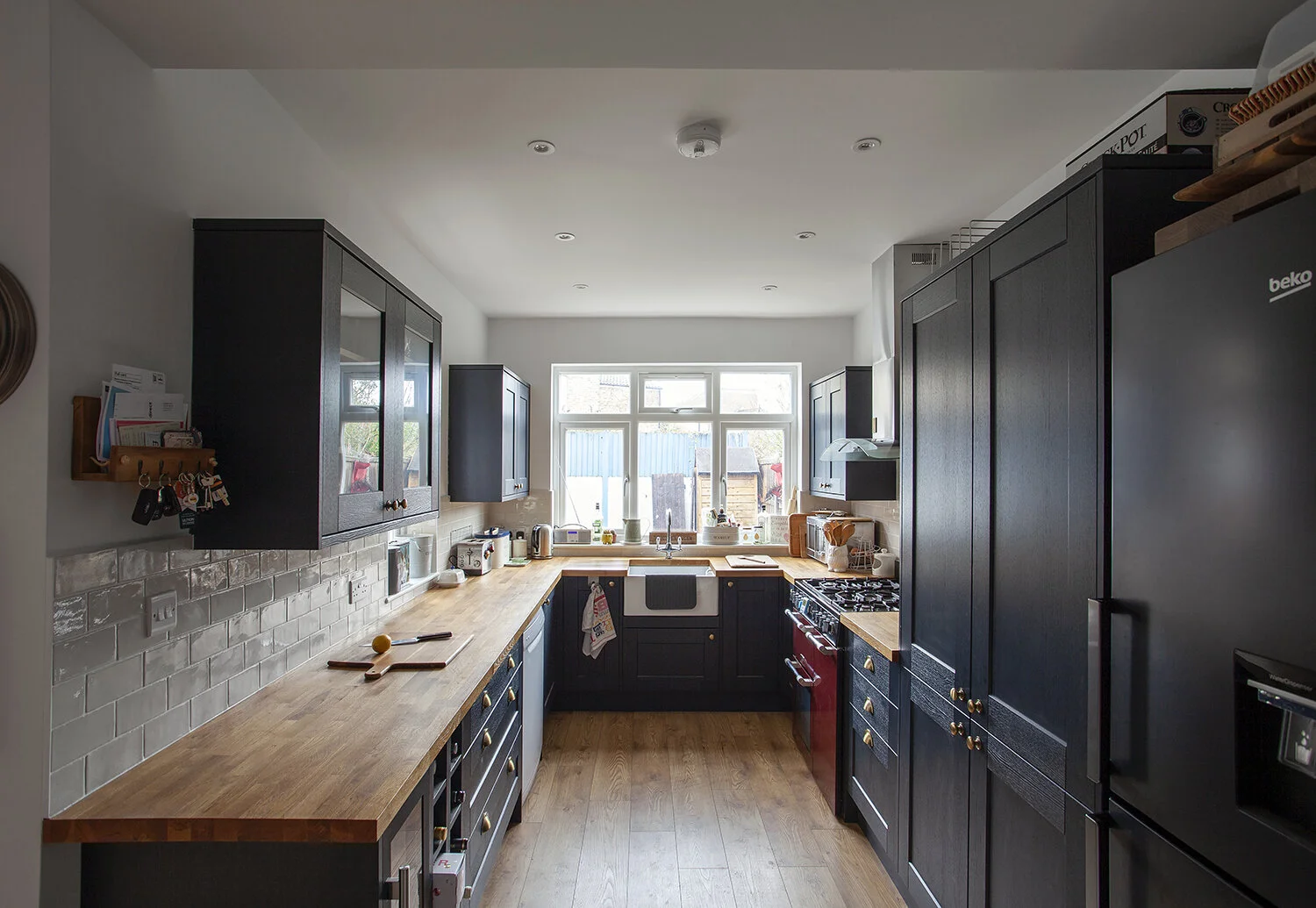
east-sheen-extension-kitchen-03.jpg

Project Schedule

Year: 2017-2018

Location: East Sheen, London Borough of Richmond upon Thames

RIBA Design Stages: 0-5

Architect: Square One Architects

Structural Engineer: Glencross & Hudson

Building Control: Building Control Approval

The client for this project, a family of 5 with 3 small children, came to us in 2017 with a very specific brief. They had obtained planning permission using another architectural firm; however, they were not happy with the overall design.

The original project included a side extension, a rear extension and a first-floor infill extension. Despite getting planning approval for a significant additional square footage, the client was not very happy with the overall design and felt that not enough time and care had been spent in the  initial design phases (concept and schematic design) in order to agree a plan.

In this instance our first goal was to optimize the existing plan. Since the very beginning it became obvious that we would have had to go back to the planners with an amendment to the original planning application. The new plans were thoroughly discussed with the client until the layout was totally agreed.

Revised drawings were then submitted and subsequently agreed with the council. The side extension included a bedroom with a small living space and an en-suite bathroom to be used as a granny annexe for the clients’ aging parents.

The rear extension included an open plan kitchen, dining area and living space for the family.

The first-floor infill extension included a new large family bathroom (the original property was curiously lacking a shared bathroom and featured only two en-suite bathrooms).

The client also asked us to design a loft extension for the property an include a bedroom with an additional en-suite bathroom to be used by their au-pair.

The original four-bedroom house was turned into a generous 6-bedroom property with a well-proportioned family bathroom, three en suite bathrooms and plenty of open plan space to be shared with the client’s growing family. We were thoroughly pleased with the results and received a very positive feedback from the client.

BEFORE AND AFTER IMAGES

Rear elevation

Rear elevation

Kitchen and dining area

Kitchen and dining area

Kitchen and living area

Kitchen and living area

Ground floor entrance

Ground floor entrance

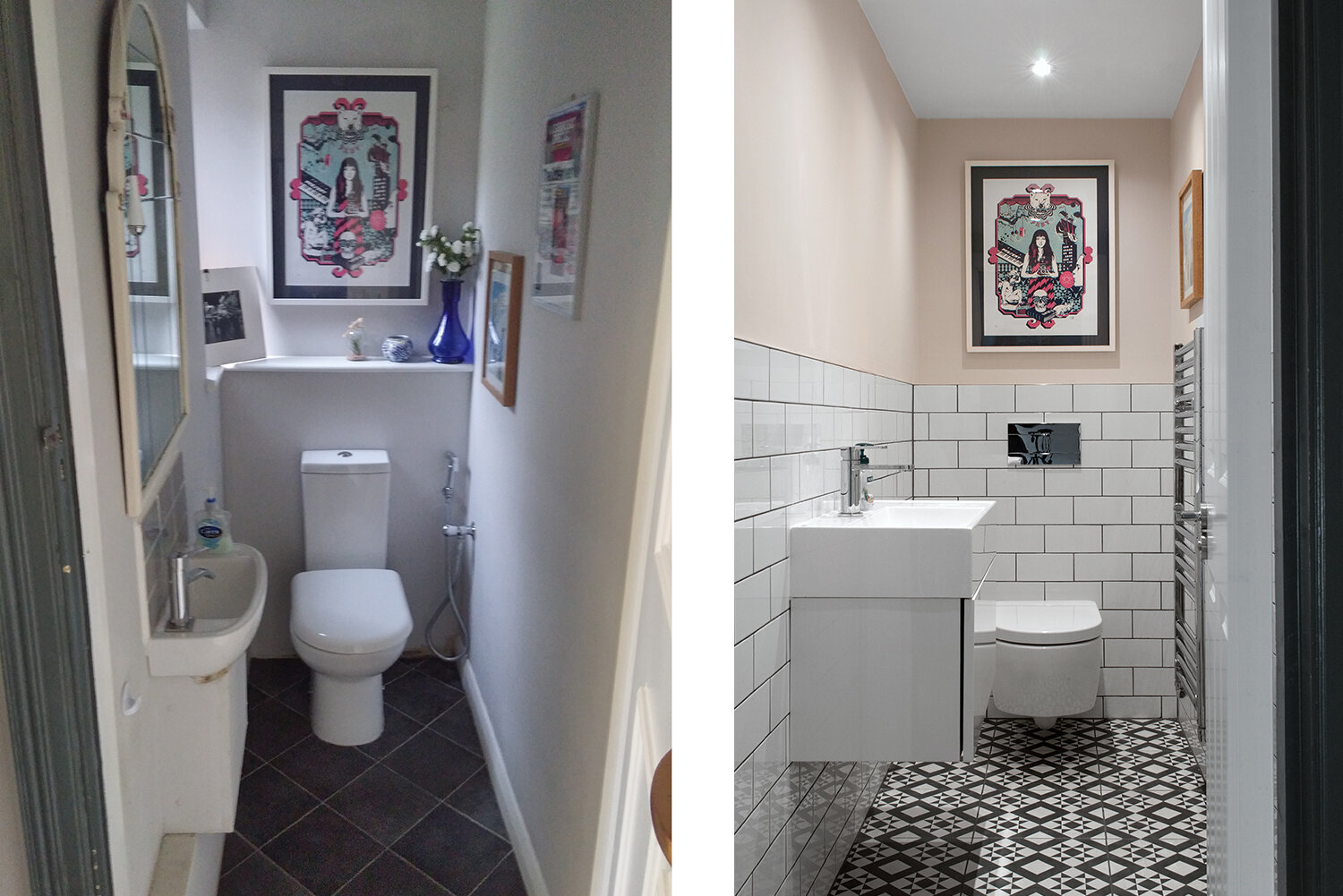
Guest WC

Guest WC

Project schedule #1 Full house refurbishment in Hampton Hill

 
hampton-hill-kitchen.jpg

Project schedule

Year: 2017-2019

Location: Hampton Hill, London Borough of Richmond upon Thames

RIBA Design Stages: 0-5

Architect:

Square One Architects

Structural Engineer:

Glencross & Hudson

Building Control:

Building Control Approval

The client for this project approached us in 2017 with an initial briefing that included a ground floor side return extension, alterations to the existing stair and several internal alterations to the ground and the first-floor layout.

The existing property was a typical two ups two downs terraced house in Hampton Hill. The property dated back to the late XIX century and in need of renovation. During the initial phases of the design we agreed with the client to turn the original stair by 90 degrees in order to provide a more rational layout. The initial project also included a ground floor side-return extension to form a new living and dining area to the rear and large bi-folding doors.

After obtaining planning approval for these alterations the clients’ plans changed due to their personal circumstances and they decided to add a loft extension to the project.

Sudden changes in the initial brief are not unusual and we as are always happy to accommodate any additional requirement with flexibility.

The brief for the loft extension included two new bedrooms and the family bathroom with one of the bedrooms to be used as a study or guest bedroom.

A new planning approval was obtained for the loft extension and subsequently detailed drawings were produced for both tender and construction purposes.

The refurbishment was carried out within the clients’ budget with no delays, thanks to the professionalism of the contractor, but also to the clarity of our drawings and instructions.

The result is a 4-bedroom house with 2 family bathrooms and well laid out distribution spaces that benefit from additional daylight created by a skylight that was been placed on top of the new stair.

This full house refurbishment has been a great success and we are very happy that the clients, a family of two are now enjoying their extended property.

Before and after images

Ground floor kitchen and dining

Ground floor kitchen and dining

First floor bathroom

First floor bathroom

Rear view

Rear view

Our new project for a house extension in Byfleet & New Haw

A pretty dramatic before and after image of the front our recent project for a detached house in Byfleet and New Haw

house-extension-byfleet-new-haw-front.jpg

The pictures above show the dramatic difference between the existing detached house in Byfleet and New Haw before and after the extension and refurbishment works.

When we first met the client in 2018, we found a property with lots of potential but very tired both externally and internally. The house needed a full refurbishment and several improvements were also necessary in order to maximize the use of internal spaces.

In the picture to the right our first-floor side extension can be seen to the left. The purpose of this extension was to add a new dressing area and en-suite bathroom with a window on the front of the house. Both the dressing room and en-suite have been designed to be directly connected to an existing bedroom that the clients decided to use as their master bedroom.

The project also included new rendering to the front, sides and rear of the property and the ground floor rear extension along with several internal alterations to create an open plan space at ground floor level.

It was a remarkably interesting project, with a proactive client who put a lot of stress on the importance of design.

We are incredibly happy with the result and final pictures of the standard property can be seen here.

When we went to site we also filmed a video showing the ground floor of the property. It can be visualized here.

New photos of our project for a house extension in Teddington

Check out the new external photos of our project for a house extension in Teddington including the new external patio. Click here

We are really pleased with these Teddington house extension photos by Emanuelis Stasaitis.

He is always very good at getting the best shots out of our projects and I think these home extension photos prove the point.

This home extension in Teddington was designed between 2017 and 2018 for a young family of four with two children.

It was it was a great experience from our point of view because the clients proved to be informed and engaged from a design perspective at any stage.

The project involved the ground floor side and rear extension and complete remodeling of the floor plan.

The existing property was a typical 1930s semi-detached house with large garden at the rear. As it often happens the property had been extended in the past with a conservatory that used to be too hot in the summer and too cold in winter.

The initial client idea was to demolish the conservatory and carry out a rear extension however it soon became apparent that adding a side extension (to match the one in the neighboring property) would have provided a very useful amount of internal space for service rooms such as a guest WC a utility room and a small study.

The client had an interest into industrial architecture, and it was decided to keep one of the structural steel beams visible. In these cases, it is essential to use an intumescent paint for fire rating purposes. We agreed with the client to retain the beam that subdivides the dining area from the living space in order to create a feature.

The client also decided to supply Crittall style doors and windows that help define the character of the extension.

We have many home extension photos in our project page you can have a look by clicking here

You can also see the project schedule here.

Hopefully these photos will be able to inspire potential clients or provide some home extension ideas.

Render vs completed photo of our latest house extension in Byfleet & New Haw

It's always interesting to look back at the design and evaluate how the final product compares to the initial intent. In this image a photo realistic render (above) is compared to a final image of a kitchen space.

extension-byfleet-new-haw-before-after.jpg

It is always essential to keep track of the relationship between designed spaces and final build project in order to verify the validity of our vision and take note of what has been improved during construction or what could have been built differently.

In the case of this project for or a rear and side extension to detached house in Byfleet and New Haw we were pleased to see that our 3D model rendering (first image above) looks very similar to what the contractor delivered on site.

First and foremost, the size of the openings and the subsequent amount of daylight received by the internal spaces was correctly predicted by the virtual analysis carried out through the rendering engine. Second, the materials that the client had chosen where confirmed to be a good match for the type of space that we had designed.

This project proves once again that 3D modelling and rendering tools can provide an invaluable help to both the Architect and the client.

By using these tools, the Architect can convey an idea in a very straightforward manner and the client can understand it right away, taking the necessary decisions when requested by the Architect.

We feel that the best stage to provide this type of drawings to a client is detail design where decisions about materials and certain technical details need to be finalised. Although there is a benefit in producing preliminary 3D models at earlier stages of the design, we see little point in generating super realistic images without any decision being made by the client regarding large items such as finishes, kitchen etc…

House extension and refurbishment in Hampton Hill

We are excited to present our new project, a home expansion and renovation in Hampton Hill. We have a video that shows the design from start to finish, giving you a clear view of the transformation. Be on the lookout for more pictures that will showcase the skilled work and careful design that went into creating this space.

At ground floor level, our clients requested a side return extension to expand their living space. This involved the removal of an existing bathroom to make way for an open and inviting area that encompassed both a new kitchen and a dining area. Additionally, one of the main design challenges we tackled was the reorientation of the existing staircase by a 90-degree angle within the new kitchen/dining space.
Moving up to the first floor, we transformed one of the bedrooms into a generously proportioned bathroom. By removing an existing partition, we successfully fashioned a second spacious bedroom on this floor, maximizing the available space to meet the needs of the family.
Expanding further at the loft level, we introduced two brand-new bedrooms and a family bathroom. This addition not only complemented the existing layout but also provided our clients with an accommodating and versatile space for their growing household. We took great pleasure in designing this project specifically tailored for a young couple, and we have full confidence that the thoughtfully crafted spaces will cater perfectly to their evolving needs.

Rear extension in Hampton

We are excited to share two short videos of our newest project—an amazing addition to the back of a house in Hampton. More pictures will be coming soon!

The client initially engaged our services back in 2018, seeking assistance with a rear extension and internal alterations for their four-bedroom terraced house in Hampton. While the upper levels of the property had undergone renovations, it was evident that the ground floor did not uphold the same standards. Displeased with the overall layout, the client felt that the space was not maximized to its full potential. In addition, the house contained a non-original rear extension from the 1980's. This extension, lacking in quality and failing to fully utilize the plot's width, raised concerns. As a result, we developed a plan to design a new rear extension, which would replace the outdated one and seamlessly integrate a new open space comprising a kitchen, dining area, and small seating space. The spacious layout incorporates a stylish kitchen island and a generous 6-seater table. Furthermore, to enhance functionality, we incorporated a small guest WC, utility space, and under stair storage on the ground floor. Additionally, to restore the original charm, we reinstated the front reception room by removing a previously blocked-off partition wall. The back of the property features beautiful and well-crafted doors and windows with clean lines, supplied by Fabco Sanctuary. These architectural elements add a touch of modern style and timeless beauty to the overall design, enhancing both the look and functionality of the property.

A Deck overlooking the Thames in Hampton

A fun little project of a new deck for a friend's house that was recently recently built. The house is located on a small island in the river Thames and the deck overlooks Garrick's temple and Villa to the north, quite a view!

hampton-deck-thames.jpg

One of the interesting features of the new deck is the integrated gutter system that allows to collect water below the deck in a seamless fashion.

IMG-20190609-WA0023.jpg

A project for a new deck to a house situated on Garrick’s Ait in the middle of the River Thames has been completed.

The new deck is stunning, and it contributes to make the most out of the beautiful existing views over Hampton including Garrick’s temple, Garrick villa and St Mary's Church.

The existing deck needed to be repaired and it was decided with the clients to remove one of the stairs that lead directly to the river.

This decision generated more space for the deck itself without the interruption of one of the stairs.

The existing handrail was replaced with a new timber balustrade with horizontal elements that is more in keeping with the nautical theme of the house and the island in general.

The new timber deck rich tones create a beautiful contrast with the striking colours of the river and the landscape in front.

Square One architects have also been involved in the detailing of the new drainage system that is concealed below the deck. This system is a more efficient and elegant way to get rid of rainwater and contributes to the simple yet beautiful look of the new deck.

The final images of the project can be seen here.

new haw project now completed

Our project in New Haw is finished - we've successfully completed a rear extension and first floor side extension for a large detached property. The carefully designed additions seamlessly blend with the existing structure, improving both its function and appearance. The rear infill extension provides a lot of space for a modern living area, great for hosting guests or spending time with family. The first floor side extension adds extra rooms for bedrooms or a home office, providing flexibility for the homeowners' changing needs. The completion photos show the impressive transformation, displaying the attention to detail and high-quality workmanship that went into the entire project.

As architects at Square One Architects, our dedication to lighting design is always at the forefront of our work. We understand the importance of both natural daylight and artificial lighting in creating spaces that not only look stunning, but also enhance the overall well-being of those who inhabit them. From the moment we begin a project, we carefully consider how to maximize natural light, allowing it to filter through strategically placed windows and skylights, while also incorporating innovative artificial lighting solutions. The photos showcased here serve as a testament to our commitment as a practice to design spaces that are not only well ventilated and bright, but also transform the quality of life for our clients, allowing them to thrive in spaces that inspire and uplift.

To learn more about this project and see the incredible before and after photos, please visit our website, where you'll find a detailed overview and a captivating visual journey.